The Treaty of Ponteland, 1244: When Two Kings Made Peace on the Pont
In August 1244 the King of Scots camped at Ponteland while Henry III's army gathered at Newcastle. Instead of a battle there was a peace, sealed with a royal betrothal. The full story of the Treaty of Ponteland, what it did and did not decide, and where to find it in the town today.
In the summer of 1244 two armies faced each other across a few miles of Northumberland. Henry III of England had gathered his forces at Newcastle. Alexander II, King of Scots, was encamped at Ponteland. Both sides had marched north or south expecting a fight. What they got instead, in the middle of August, was a peace, and a promise that a three-year-old English princess would one day marry the Scottish king's infant son.
That agreement is known to historians as the Treaty of Newcastle, after the place where Henry's court sat. In Ponteland it has always been remembered as the Treaty of Ponteland, because this is where the Scots were and where tradition says the deal was struck. Our history and heritage guide gives it a sentence or two. This is the longer story: why the kings fell out, what they agreed, what the treaty did not do, and what is left of the Ponteland they would have known.
Two kings and an unfinished argument
The quarrel of 1244 had deep roots. For most of a century the kings of Scots had claimed the three northern English counties of Northumberland, Cumberland and Westmorland, and the kings of England had refused them. A royal meeting at Newcastle in September 1236 failed to settle the matter.
A year later it was settled, or seemed to be. In September 1237 Alexander II and Henry III met at York, with the papal legate Otto present, and agreed what became known as the Treaty of York. Alexander gave up his claim to the three counties. In return he was to receive English lands worth £200 a year, although that part of the bargain was only put into effect in 1242. The Treaty of York fixed the Anglo-Scottish border in a form that has remained almost unchanged ever since, apart from the Debatable Lands in the west and the later fate of Berwick.
The two kings were also brothers-in-law. Alexander's queen was Joan, Henry III's sister. When Joan died in March 1238, one of the personal ties holding the peace together went with her. In May 1239 Alexander married again, and his choice alarmed the English court. His new queen was Marie de Coucy, daughter of the French nobleman Enguerrand de Coucy, and a Scottish king with a French wife raised fears in England of an alliance between Scotland and France.
Best for: The border between England and Scotland was settled at York in September 1237, not at Ponteland. The 1244 agreement confirmed the York terms rather than drawing a new line.
Why Henry marched north
The fullest account of 1244 comes from Matthew Paris, the St Albans chronicler, whose English History has a chapter headed "Of the dispute between the English and Scotch kings". Paris lists Henry's grievances. Walter Comyn, one of the most powerful Scottish nobles, had built two castles, one in Galloway and one in Lothian, which the English saw as a threat. The Scots were said to be in a confederacy with the French. Exiles from England, Geoffrey Marsh among them, were being sheltered in Scotland. And Alexander had married the daughter of "Engelram de Coucy", the French match that had worried the English for five years.
Henry gathered an army and marched to Newcastle upon Tyne. Eneas Mackenzie's history of Newcastle, published in 1827 and drawing on Paris and on Rymer's collection of treaties, puts it plainly: "king Henry, in 1244, collected his army at Newcastle", and "the king of Scots was encamped at Ponteland".
Paris gives figures for both sides: about 5,000 well-armed English knights with a great force of foot soldiers, and on the Scottish side about 1,000 armed knights and around 100,000 foot. Medieval chroniclers were not careful with large numbers, and historians treat counts like these as an impression of scale rather than a muster roll. What the figures do tell us is that both sides came prepared for a serious battle. Paris adds that the Scots had made their confessions and been encouraged by their preachers, ready to fight if it came to that.
Why Ponteland?
Ponteland sat on the natural road between the Scottish border and Newcastle, about eight miles north-west of the town, at a crossing of the River Pont. For an army coming down from the north it was a sensible place to stop: close enough to Newcastle to negotiate, far enough away not to provoke a fight by accident.
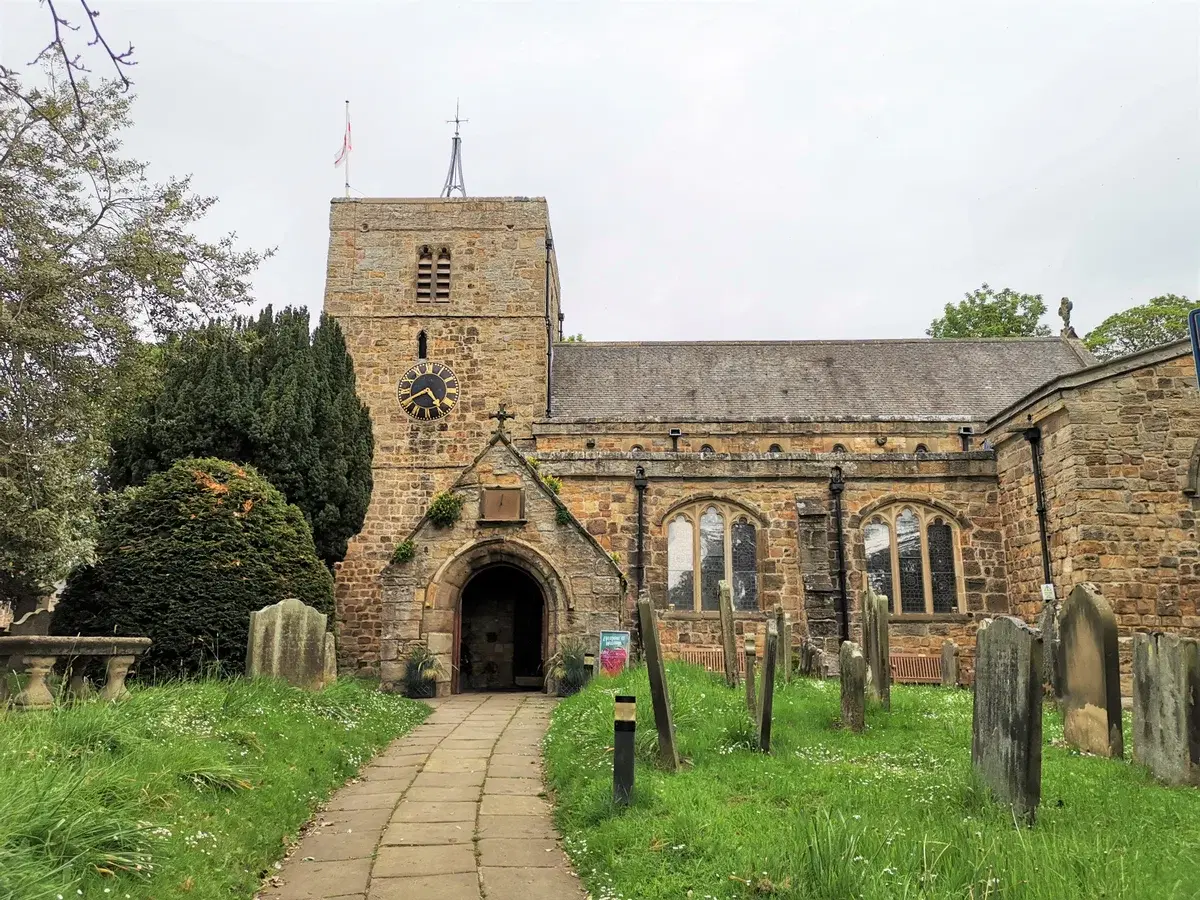
The village the Scots found was small, but its church was already old. St Mary's tower dates from the 12th century, and its west doorway still has the chevron decoration of Norman masons. The long chancel, the chancel arch and the north transept are 13th-century work, so in 1244 parts of the church may have been new or still being built. The chancel arch rests on carved corbels depicting Adam and Eve. Our guide to St Mary's Church tells its story in full.
Much of what visitors now think of as medieval Ponteland did not yet exist. The tower that survives inside the Blackbird and the Vicar's Pele by the church are both 14th-century buildings, put up in a later and more violent age of border warfare. The kings' men in 1244 would have seen the church, the river, and very little else of stone.
The peace of August 1244
What happened next was a negotiation, not a battle. Paris says the peace was brought about "by the management of Earl Richard", Henry's brother Richard of Cornwall, together with other nobles who did not want to see Christian blood shed. Mackenzie, following other sources, credits "the mediation of the archbishop of York and some of the nobility". The prior of Tynemouth, too, worked to bring the two sides together. The accounts agree that it was a settlement brokered by churchmen and great lords rather than one imposed by force.
The agreement was reached on 14 August 1244, the eve of the Feast of the Assumption. Paris dates it to around the Assumption. A later account quoting the chroniclers gives the date as "the vigil of the Assumption", which is 14 August.
Best for: The peace was agreed on 14 August 1244. The English king's army was at Newcastle and the Scottish king's at Ponteland.
What the two kings agreed
The terms are recorded in a charter that Alexander sent to Henry afterwards. Paris says the prior of Tynemouth delivered it to the English king the following Christmas, and the full text is printed in Rymer's Foedera, the great 18th-century collection of English treaties.
The heart of it was a promise of good behaviour. Alexander undertook that he would not make war on Henry except in self-defence, and that he would not ally himself with Henry's enemies. That was a direct answer to the fear of a Scottish-French alliance. The charter also confirmed the agreements made at York in 1237 in the presence of the legate Otto, the settlement that had fixed the border.
The second part was a marriage. Alexander's son, also called Alexander, was to marry Henry's daughter Margaret. The boy was not yet three. Margaret had been born at Windsor on 29 September 1240, so she was three years old when her future was agreed beside the Pont. Royal betrothals of small children were common in the 13th century: they turned a political deal into a family one.
Paris also records who guaranteed the promise. Four men swore on the Scottish king's soul: Alan Durward, Henry de Baliol, David de Lindsay and William Giffard. The bishops of St Andrews, Glasgow, Dunkeld and Dunblane added their names, as did the earls Patrick of Dunbar, Malcolm of Fife, Malise of Strathearn, William of Mar, Alexander of Buchan and David de Hastings of Atholl, along with Walter Comyn, Earl of Menteith, the man whose castle-building had helped to start the crisis. Both sides agreed to submit to the jurisdiction of the Pope if the agreement were broken.
Back in England, the marriage had a price. Mackenzie notes that parliament granted a scutage, a tax paid in place of military service, towards Margaret's marriage portion.
Did the Treaty of Ponteland set the border?
You will sometimes read that the treaty agreed at Ponteland "set the border" between England and Scotland. It is an appealing claim for a town to make, but it gives 1244 credit that really belongs to 1237.
The line itself was settled at York, when Alexander gave up his claim to the northern counties. What happened in 1244 was the reaffirmation of that settlement at a moment when it looked as if it might collapse. Alexander's charter confirmed the York agreement and added new promises on top of it. That still matters. Without the peace of 1244 there could have been a war over the very questions York had answered, and the York settlement survived largely because both kings recommitted to it here.
The fairest way to put it is this: the Treaty of York drew the line, and the Treaty of Ponteland kept it.
The plaque at the Blackbird
Local tradition places the signing in a specific spot. A plaque outside the Blackbird records "the signing of a peace treaty between Henry III of England and Alexander of Scotland" on the knoll in the marsh where the inn now stands. Our guide to Ponteland Castle and the Blackbird Inn covers the building itself.
It is a lovely story, but it is a tradition rather than a recorded fact. None of the chronicle sources we have read names the exact place where the agreement was made, and Henry III himself was at Newcastle. Nor was there a castle on the site in 1244. What is safe to say is that the Scottish army was at Ponteland, that the negotiations took place between the two camps, and that Ponteland has kept the memory of the peace for nearly eight centuries.
What happened next
For a while the peace held. Alexander II died on 8 July 1249 on the island of Kerrera, off the west coast of Scotland. He was buried at Melrose Abbey. His son, the boy named in the 1244 agreement, became King Alexander III at the age of seven.
The marriage promised at Ponteland duly took place. At Christmas 1251, in York Minster, Margaret of England, aged eleven, married Alexander III, aged ten. Before the wedding Henry III knighted the young king. The match brought the two royal families together just as the 1244 agreement had intended.
Margaret became Queen of Scots and had three children: a daughter, Margaret, born in 1261, who married King Eric II of Norway; a son, Alexander, born in 1264; and a younger son, David, born in 1272. None of them lived long. David died in 1281, Margaret in 1283 and Alexander in 1284. Queen Margaret herself had already died at Cupar Castle on 26 February 1275, and was buried at Dunfermline.
Best for: The marriage agreed at Ponteland in 1244 took place in York Minster at Christmas 1251, when Margaret of England was eleven and Alexander III was ten.
Finding the treaty in Ponteland today
There is no monument to the treaty, and no battlefield to walk. But it is possible to stand in places that link directly to 1244.
- St Mary the Virgin. The 12th-century tower and Norman west doorway were there when the Scottish army arrived, and the 13th-century chancel arch with its Adam and Eve corbels belongs to the same century as the treaty. The church is Grade I listed.
- The Blackbird. The plaque outside records the local tradition of the treaty, and the medieval tower inside is a reminder of the more dangerous century that followed.
- The River Pont. The crossing that made Ponteland a natural stopping place on the road south is still the heart of the village.
All three are close together and make an easy short walk. Our Ponteland heritage walk links them with the rest of the town's history.
Why it still matters
Most treaties are remembered for the wars they ended. The Treaty of Ponteland is remembered for the war that did not happen. Two armies gathered in Northumberland in the summer of 1244, and the matters that might have been settled by battle were settled by agreement: a promise of peace, a confirmation of the border agreed at York, and a betrothal between two small children who would grow up to be King and Queen of Scots.
It was not the moment the border was drawn. It was one of the moments it held. For a village of a church, a river and a few houses, that is a remarkable thing to have witnessed.
Sources: Matthew Paris, English History (trans. J.A. Giles); Eneas Mackenzie, Historical Account of Newcastle upon Tyne (1827), via British History Online; the Historic England listing for St Mary's Church; and published accounts of the treaties of York (1237) and Newcastle (1244). Know more about the treaty's place in Ponteland's memory? Get in touch.
Never miss what’s on
Join the weekly Ponteland.live digest — the best events, news and local tips, straight to your inbox. One email a week.
What's On
Ponteland Memorial Hall Quiz Night
7:00 PM · Ponteland Memorial Hall, Darras Road, Ponteland, NE20 9NX
Callerton Garden and Flower Club: Holly, Ivy and Santa
2:00 PM · Ponteland CIU, Merton Way, Ponteland, Newcastle upon Tyne
Ponteland Rep: A Musical Christmas Carol
7:00 PM (also 14 Nov 2:00 PM & 7:00 PM, 15 Nov 2:00 PM) · Ponteland Memorial Hall, Ponteland, Newcastle upon Tyne