The History and Heritage of Ponteland
A 12th-century church, a fortified vicarage and an inn built on the ruins of a medieval castle. The story of Ponteland is written into three remarkable buildings that still stand on the River Pont.
Behind the shops of Main Street and the leafy roads of Darras Hall, Ponteland is one of Northumberland's older settlements, a village that grew up where an ancient road crossed the River Pont, and whose very name comes from that bridge over the Pont. Its long history sits close to the surface, told most vividly through three buildings that still stand within a few minutes' walk of one another. Together they trace Ponteland's story from Norman times, through the centuries of border warfare with the Scots, to the comfortable commuter town of today.
St Mary the Virgin, the constant on the Pont
The parish church of St Mary the Virgin is essentially a product of the 12th century, standing on the bank of the River Pont with a solid Norman tower at its heart. From Saxon times through the wars with Scotland and down to the present day, it has been the one fixed point in the life of the village.
Like many Northumberland churches close to the border, St Mary's was also a place of refuge: in medieval times it was a "defensive" church, where local people could shelter when raiders threatened. The building was much restored through the 19th century, but its medieval bones, tower, nave, aisles and chancel, remain, and it is still an active parish church today.
Best for: A working parish church and the oldest building in the village, best appreciated from the riverside path.
The Vicar's Pele, a fortified vicarage
A short step from the church once stood the Vicar's Pele, a 14th-century pele tower built as a defensive stronghold during the long wars with the Scots. Pele towers, thick-walled, easily defended stone towers, are a distinctive feature of the old Anglo-Scottish border country, and every parish of any standing wanted one.
Ponteland's example was rebuilt in the 17th century and used for many years as the vicarage, before most of the structure was demolished in the 19th century. Though little now survives above ground, the Vicar's Pele is a reminder of just how exposed and contested this landscape once was.
The Blackbird Inn, a pub built on a castle
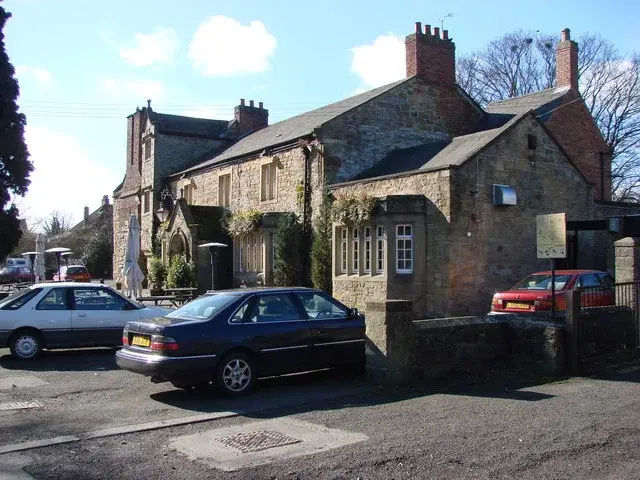
The most remarkable survival of all is The Blackbird on North Road, one of the oldest inns in the North East and a genuine piece of medieval Ponteland. The pub incorporates the surviving tower of Ponteland Castle, a fortified manorial complex whose barrel-vaulted basement and newel (spiral) stair are the only parts left of a much larger building.
That castle met a violent end: it was largely destroyed by the Scottish army under the Earl of Douglas in 1388, the day before the famous Battle of Otterburn. What remained passed through the centuries and, in 1597, Mark Errington rebuilt the old castle as a manor house, living there as a country gentleman; the property stayed in his family for some two hundred years before becoming, in time, an eating house and then a licensed inn. A major restoration in 1935 preserved the ancient tower and a Tudor fireplace that can still be seen inside. The building is now Grade II* listed, and, as with any historic pub, comes with its own local legends, including a supposed hidden tunnel running from behind a fireplace towards the church.
Best for: History with a modern menu. The Blackbird is both a listed monument and a working pub and restaurant.
A landscape shaped by the border
The thread running through all three buildings is the centuries of conflict between England and Scotland. A defensive church, a pele tower and a castle in a single small village tell you that Ponteland sat on a dangerous frontier, repeatedly raided by "reivers" and armies moving between the two kingdoms. The 1388 raid that wrecked Ponteland Castle was part of the same campaign that produced the Battle of Otterburn, immortalised in the border ballads.
By the 18th and 19th centuries the danger had long passed, the pele had become a vicarage, and Ponteland settled into life as a quiet Northumberland village. The 20th century brought the Darras Hall garden village and, later, Newcastle's growth outwards; but the medieval core, church, pele site and castle-inn, is still there to be found.
Seeing it today
The three sites sit close together around the old heart of the village, between Main Street, North Road and the river, and make an easy short heritage walk. Start at St Mary's on the Pont, note the site of the Vicar's Pele nearby, and finish at the Blackbird, where you can stand inside the walls of a medieval castle with a drink in hand. For the wider setting of Darras Hall and the modern town, our Darras Hall guide picks up the story from 1907 onwards.
Know a piece of Ponteland history we should add? Get in touch, we'd love to hear it.
Never miss what’s on
Join the weekly Ponteland.live digest — the best events, news and local tips, straight to your inbox. Free, one email a week.
What's On
Darras Hall & Ponteland Community Litter Pick
12:00 PM - 1:30 PM · Darras Hall Estate Committee Offices, Broadway, Darras Hall, Ponteland
Ponteland Police Drop-In
5:30 PM - 6:30 PM · Ponteland Leisure Centre, Callerton Lane, Ponteland, Newcastle upon Tyne, NE20 9EG
Ponteland u3a: Life as a Diplomat's Wife
2:00 PM · St Mary's Parish Centre, Thornhill Road, Ponteland, NE20 9PZ