Prestwick Carr: Ponteland's Wild Wetland, Its Birds and How to Visit
Once a lake shared by seven townships, Prestwick Carr on Ponteland's eastern edge is now a Site of Special Scientific Interest known for owls, waders and rare winter visitors. Its history, wildlife, and how to watch it from the lanes without trespassing.
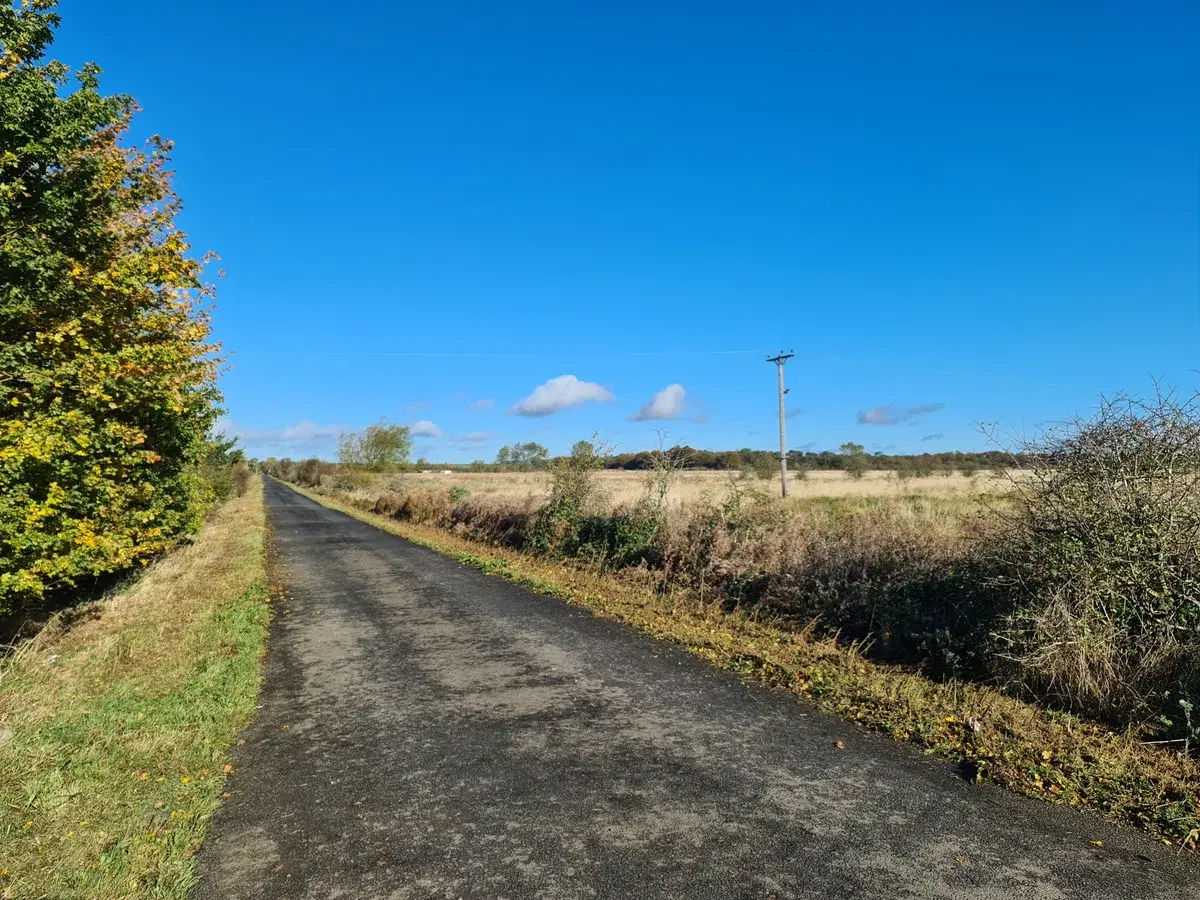
A few minutes' drive east of Ponteland, the fields flatten out into a wide, low basin of rough grass, rushes, ditches and dark woodland. This is Prestwick Carr, a wetland on the edge of Newcastle that for centuries was one of the wildest places in the area. It was once a lake, then a long-running drainage project, and is now a Site of Special Scientific Interest and one of the best places near the city to see owls hunting on a winter afternoon.
It is also a slightly unusual place to visit, because most of it has no public access at all. This guide explains what the Carr is, what lives there, and how to enjoy it from the lanes around it.
Where it is
Prestwick Carr lies between Ponteland and Dinnington, on the eastern edge of Ponteland parish and close to the village of Prestwick. The Northumberland Wildlife Trust gives its location as grid reference NZ 192 733, postcode NE20 9UD. Water from the Carr drains into the River Pont.
From lake to farmland
In origin Prestwick Carr is a basin mire, a peat-filled hollow where water collects. In historic times it was often a shallow lake, and the land was common ground shared by seven surrounding townships: Ponteland, Berwick Hill, Horton Grange, Brenkley, Mason, Dinnington and Prestwick.
Its history is long. Northumberland Archives notes that its earliest recorded name, "Merdesfen", dates from the 12th century. Medieval religious houses held rights here: Newminster Abbey and St Bartholomew's Nunnery had rights to cut peat and turf, and in the 13th century Tynemouth Priory was granted pasture rights and permission to divert water. In 1890, thirteen bronze vessels were found on the Carr, thought to be Roman kitchen equipment.
For a long time, landowners wanted the Carr drained. Some small-scale drainage was done in the 18th century, and the idea of enclosing it was discussed around 1807. In 1809 J. Watson proposed a straight cut in the River Pont to bypass the Carr, and in 1835 Thomas Bell revived the plans. The Carr was finally drained and enclosed in the 1850s, and the Newcastle Historic Environment Record dates the enclosure award to 25 March 1860. The hoped-for profits never really appeared. A last drainage scheme was carried out in 1945 to 1946.
By 1890 the historian Thomas Hodgkin could describe the former haunt of wildfowlers and naturalists as "two square miles of common-place Northumbrian cornland". The Carr also had an odd administrative status: it was an extra-parochial area, outside any parish, and in the 1891 census its population was recorded as nil.
Best for: Prestwick Carr was common land shared by seven townships, including Ponteland, until it was drained and enclosed in the 1850s. The enclosure award is dated 25 March 1860.
A Site of Special Scientific Interest
Drainage shrank the wetland, but it never quite tamed it. Prestwick Carr was first notified as a Site of Special Scientific Interest in 1968, and the designation was revised in 1986. The SSSI covers 51.4 hectares, 48.3 hectares of it in Tyne and Wear and 3.1 hectares in Northumberland.
Natural England's citation describes a mix of wetland habitats: tall fen dominated by soft rush, carr woodland of alder and downy birch, and a relict raised mire, now within a pine plantation, where hare's-tail cottongrass, heather and the rare bog-rosemary grow. The fen has yellow iris, meadowsweet, marsh cinquefoil and ragged-robin, as well as locally rare plants including slender tufted-sedge, tubular water-dropwort and greater spearwort. The ditches hold water-crowfoot, pondweeds and water-plantain.
The wider area is managed partly by the Northumberland Wildlife Trust, which looks after a large area of wet grassland to the south, using rush cutting and grazing to keep it in good condition for wildlife. Much of the core of the site is owned by the Ministry of Defence. The Trust describes the Carr as a relic of lowland raised mire, one of the rarest habitats in the world, and points out that the wetland also helps to reduce flood risk and improve water quality downstream.
Birds and other wildlife
Prestwick Carr is best known for its birds.
Winter. The Carr floods seasonally and holds wildfowl and waders through the winter. It is famous locally for owls: barn owls and short-eared owls hunt over the rough grassland.
Spring and summer. The 1986 SSSI citation lists curlew, redshank, snipe, lapwing, mallard and moorhen breeding on the Carr, along with yellow wagtail and partridge, with sedge warblers and reed buntings in the rank vegetation. Water rail, skylark, willow tit and meadow pipit also breed.
Rarities. The Carr has a long record of unusual birds. A pair of wood sandpipers nested here in 1853, a remarkable record for England. More recently it has drawn great grey shrikes in autumn and winter, a woodchat shrike in 2014, a black-throated thrush in March 2016 and an eastern yellow wagtail that wintered in 2019 to 2020.
It is not only about birds. The Carr provided the first Northumberland records of the four-spotted chaser and common darter dragonflies, and the SSSI citation highlights uncommon water beetles and two notable moths, the valerian pug and the ochreous pug.
Best for: Barn owls and short-eared owls hunt over Prestwick Carr, and autumn and winter are the best seasons for birdwatchers.
How to visit
Prestwick Carr is not a nature reserve you can walk into. The Northumberland Wildlife Trust says there is no public access to the site itself. Instead, you watch it from the surrounding roads and from a viewing platform that gives a slightly raised view over the wet grassland.
Parking. Park in the small laybys on the minor road. The Trust advises against trying to drive along the minor road to the north of the Carr, and birdwatching guides warn that the roads around it are in poor condition and not suitable for cars. Walking or cycling in from a layby is the better option.
Dogs. Dogs are not permitted on the Northumberland Wildlife Trust's reserve.
Accessibility. The lane is partly accessible to wheelchair users, but surfaces are rough and can be muddy.
Facilities. There are none. The nearest public toilets are in Ponteland or at Kingston Park.
Respect the land. Much of the Carr is Ministry of Defence land and the land around it is farmed. Keep to the public roads and paths, and follow any signs on the ground.
Tips for a good visit
- Go late in the day in winter. Barn owls and short-eared owls are often out hunting towards dusk. A still, dry afternoon is ideal.
- Bring binoculars. Most of the wildlife is some distance from the road, and a telescope helps with waders and wildfowl.
- Visit after wet weather in winter to see the Carr at its most watery, when the flooded fields attract ducks and waders.
- Come in spring to hear curlew and see lapwing displaying over the grassland.
- Wear boots. The lanes and verges are often muddy.
More walks and days out
Prestwick Carr pairs well with a walk along the River Pont in Ponteland, or with other nature spots nearby. For more ideas, see our guides to the best walks in Ponteland, days out around Ponteland and things to do in Ponteland that don't cost a penny.
Sources: Natural England's SSSI citation for Prestwick Carr; the Northumberland Wildlife Trust; the Newcastle Historic Environment Record; Northumberland Archives; and the Ponteland Neighbourhood Plan. Seen something special on the Carr? Get in touch.
Never miss what’s on
Join the weekly Ponteland.live digest — the best events, news and local tips, straight to your inbox. One email a week.
What's On
Ponteland Memorial Hall Quiz Night
7:00 PM · Ponteland Memorial Hall, Darras Road, Ponteland, NE20 9NX
Callerton Garden and Flower Club: Holly, Ivy and Santa
2:00 PM · Ponteland CIU, Merton Way, Ponteland, Newcastle upon Tyne
Ponteland Rep: A Musical Christmas Carol
7:00 PM (also 14 Nov 2:00 PM & 7:00 PM, 15 Nov 2:00 PM) · Ponteland Memorial Hall, Ponteland, Newcastle upon Tyne